Published on: 24 August 2026
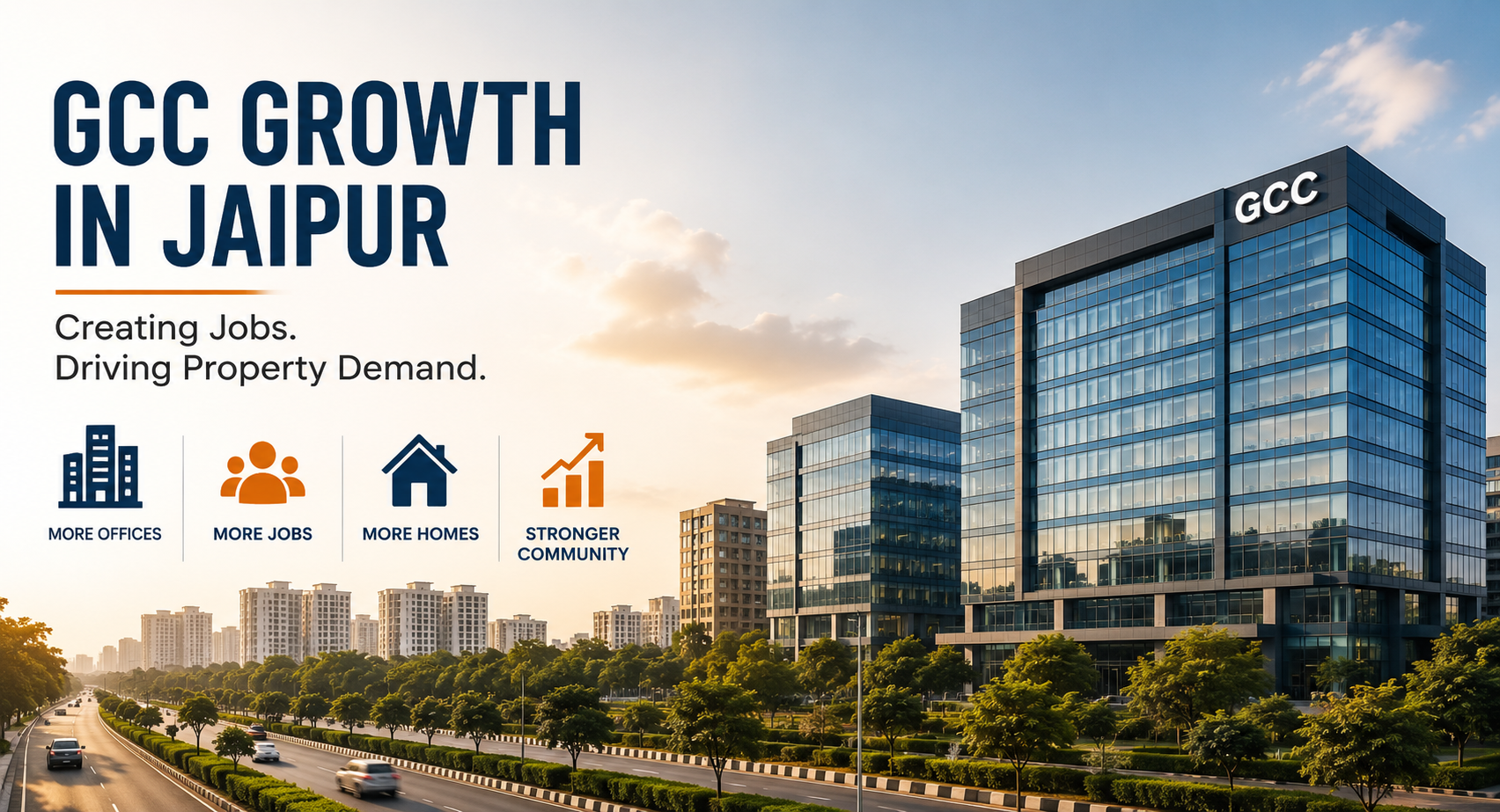
Jaipur's growing technology and business ecosystem is creating opportunities for GCCs and other knowledge-based companies. GCC expansion can potentially increase demand for office space and, indirectly, residential and retail property near employment hubs. Areas with strong connectivity, existing commercial infrastructure and access to skilled talent may benefit more than distant locations. However, investors should evaluate actual company expansion, employee demand, rental yields, infrastructure and property pricing instead of buying solely on the expectation of future GCC growth.
Jaipur is increasingly attracting attention from companies looking to establish or expand Global Capability Centers (GCCs) outside traditional metropolitan hubs. Growing access to skilled talent, improving infrastructure, connectivity and comparatively competitive operating costs are making the city more relevant for technology, finance, analytics, engineering and other knowledge-driven businesses.
For the real estate sector, this trend could have a wider impact than just office demand. GCC expansion can create additional requirements for commercial offices, rental housing, residential apartments, retail and supporting services around employment hubs. However, the effect will depend on the scale of corporate expansion, employee growth, location and available infrastructure. This guide explains how GCC Jaipur Real Estate could evolve and what property buyers and investors should consider before making decisions based on this emerging trend.
Global Capability Centers are dedicated offices or operational units established by multinational companies to handle functions such as:
Unlike traditional outsourcing models, GCCs are often closely integrated with their parent organisations and can handle specialised, high-value functions.
This makes them relevant to real estate because these operations generally require organised office environments and supporting infrastructure.
Historically, cities such as Bengaluru, Hyderabad, Mumbai, Delhi-NCR, Pune and Chennai dominated India's GCC landscape.
However, companies are increasingly evaluating emerging locations for several reasons.
Office rentals, employee costs and other operating expenses can be lower outside the largest metropolitan markets.
Universities, engineering colleges and professional institutions can provide a growing pool of skilled workers.
Better airports, highways, public transport, digital connectivity and commercial developments can make emerging cities more attractive.
Companies may prefer to diversify their workforce across multiple cities rather than concentrate operations in one location.
These factors create an opportunity for Jaipur to develop a larger technology and corporate ecosystem.
Jaipur already has several characteristics that can support technology and corporate expansion.
The city has a large education ecosystem, improving connectivity and an established services economy. Its proximity to Delhi-NCR also provides an additional advantage for businesses that need access to the broader northern India market.
The Rajasthan government has also been promoting investment and technology-led development through initiatives aimed at improving the state's business ecosystem.
For real estate, the most important question is not simply whether Jaipur attracts GCCs, but where the resulting employment and office demand will be concentrated.
The impact can happen through several stages.
The first and most direct effect is demand for commercial office space.
A new GCC needs offices, meeting spaces, employee facilities, parking and supporting infrastructure. If multiple companies expand in the same corridor, this can encourage additional commercial development.
This can create opportunities for investors evaluating Commercial Property in Jaipur, particularly in established business districts and emerging office corridors.
Once a GCC begins hiring, employees need housing.
This can create additional demand for:
The effect can be particularly noticeable in areas within practical commuting distance of major employment centres.
A growing professional workforce can support rental demand.
Young professionals may prefer:
Families relocating for employment may prefer larger 2 and 3 BHK homes.
Therefore, investors looking at Rental Property in Jaipur should monitor where corporate employment is actually expanding.
More office workers and residents can support demand for:
Over time, this can improve the commercial ecosystem around employment hubs.
Not every property category will experience the same impact.
Apartments are likely to be among the most directly connected segments because employees typically prefer housing with convenient access to workplaces.
2 BHK Flats in Jaipur can be particularly relevant for young couples and small families, while 1 BHK units may appeal to single professionals.
Senior professionals and relocated executives may create demand for larger homes in gated communities.
This can support selected Luxury Apartments in Jaipur, especially where connectivity and lifestyle infrastructure are strong.
Commercial real estate may experience the most direct impact if companies establish large operations.
Investors should evaluate office occupancy, tenant quality, lease duration and location rather than assuming that every commercial project will benefit equally.
Retail demand can grow alongside employment and residential activity.
However, successful retail depends heavily on footfall, visibility, surrounding population and tenant mix.
The effect of GCC growth is likely to be location-specific.
Areas with established connectivity, commercial infrastructure and access to residential communities may be better positioned.
Potentially relevant corridors include:
However, these should not automatically be considered "GCC investment zones."
Before purchasing, investors should verify whether actual office development, corporate leasing and employment growth are taking place nearby.
For buyers researching Property in Jaipur, this distinction is important: proximity to a general commercial area is not the same as proximity to an established GCC employment hub.
The residential impact depends heavily on employee numbers.
Imagine a company establishes a new centre with several hundred employees. Some workers may already live in Jaipur, while others may relocate.
New employees could initially rent homes.
Over time, some may decide to purchase properties after becoming established in the city.
This creates a potential progression:
GCC expansion → employment growth → migration → rental demand → residential demand → supporting retail and services
However, the scale of this impact depends on the size and nature of the GCC.
A small office with limited hiring will have a very different property impact from a large centre employing thousands of people.
Possibly, but it should not be assumed.
Property prices generally respond to multiple factors simultaneously.
If a locality experiences:
then property demand may strengthen.
But if developers add substantial housing supply at the same time, price growth may remain moderate.
Therefore, investors should look at demand versus available supply, rather than assuming that GCC expansion automatically means rapid appreciation.
Investors often focus on capital appreciation and overlook rental income.
For GCC-driven locations, rental demand may be particularly relevant because employees can initially choose to rent rather than buy.
Before purchasing an investment property, calculate:
Annual Rent ÷ Total Property Cost × 100 = Gross Rental Yield
For example, if a property costs ₹60 lakh and generates ₹20,000 monthly rent:
This is only a simplified calculation. Actual returns should account for maintenance, vacancy periods, taxes, brokerage and other expenses.
GCC expansion can make commercial property attractive, but commercial investments require careful analysis.
Before investing, check:
A commercial property marketed as being "near an upcoming IT hub" should not be treated as a guaranteed investment opportunity.
Actual corporate leasing is stronger evidence than marketing projections.
If you want to benefit from Jaipur's GCC trend, monitor these indicators regularly.
Look for confirmed office launches, expansion plans and hiring announcements.
Increasing office absorption can be an early indication of growing commercial activity.
More jobs generally create stronger underlying housing demand.
Track actual rents in nearby residential areas rather than relying only on advertised rents.
Roads, public transport and connectivity can influence how far employees are willing to live from their workplaces.
If many new apartments enter the market simultaneously, rental and price growth may remain limited.
If you're planning to Buy Property in Jaipur, don't purchase simply because a locality is associated with the technology sector.
Instead, ask:
This final question is particularly important.
A good property should have fundamental value even without a single future development.
The strongest GCC-related real estate opportunity is usually not the property closest to a proposed office project. It may be the property located within a practical residential and commercial ecosystem that can serve multiple employment hubs.
That provides diversification.
If one company delays expansion, the locality can still benefit from other businesses, schools, hospitals, retail and established residential demand.
GCC expansion is only one component of Jaipur's property market.
| Factor | Potential Impact |
|---|---|
| GCC employment | Higher residential and rental demand |
| Office development | Commercial property demand |
| Infrastructure | Better accessibility |
| Population growth | Broader housing demand |
| Education institutions | Rental demand |
| Retail development | Improved lifestyle ecosystem |
| New housing supply | Can moderate price growth |
| Interest rates | Affect buyer affordability |
This is why investors should combine GCC research with broader Real Estate Investment in Jaipur analysis.
GCC expansion can be a positive long-term factor, but it should be treated as one investment signal rather than a guarantee.
For residential investors, focus on rental demand, tenant profile, connectivity and property affordability.
For commercial investors, focus more heavily on actual leasing, tenant quality, lease terms and vacancy risk.
For end-users, the decision should primarily depend on lifestyle, commute, budget and property quality.
The safest approach is to choose a property with strong fundamentals first and treat potential GCC-driven growth as an additional advantage.
The expansion of Global Capability Centers in Jaipur could become an important long-term driver of the city's real estate ecosystem. New corporate operations can generate office demand and, over time, create additional requirements for rental homes, residential apartments, retail spaces and other supporting services. Locations with strong connectivity, established infrastructure and access to multiple employment hubs may be better positioned to benefit.
However, GCC growth should be treated as one investment factor rather than a guaranteed property-price driver. If you are evaluating GCC Jaipur Real Estate, focus on confirmed corporate activity, actual rental demand, connectivity, property valuation, infrastructure and future housing supply. A property with strong fundamentals today is generally a safer choice than one whose entire investment potential depends on an uncertain future corporate announcement.
Global Capability Centers are offices established by multinational companies to perform functions such as technology, finance, analytics, engineering, research and business operations.
GCC expansion can potentially increase office demand and create additional demand for nearby rental housing, residential property, retail and supporting services.
Residential apartments, rental homes, co-living spaces, commercial offices and selected retail properties may benefit, depending on their location and actual employment growth.
It can contribute to demand in specific locations, but it does not guarantee price appreciation. Supply, infrastructure, affordability and broader market conditions remain important.
It can be, but investors should verify actual office occupancy, corporate leasing, tenant quality, rental income and future competing supply before investing.
Areas with strong connectivity and existing or emerging commercial ecosystems may be better positioned. However, investors should verify actual corporate activity rather than relying on projected development.