Published on: 25 August 2026
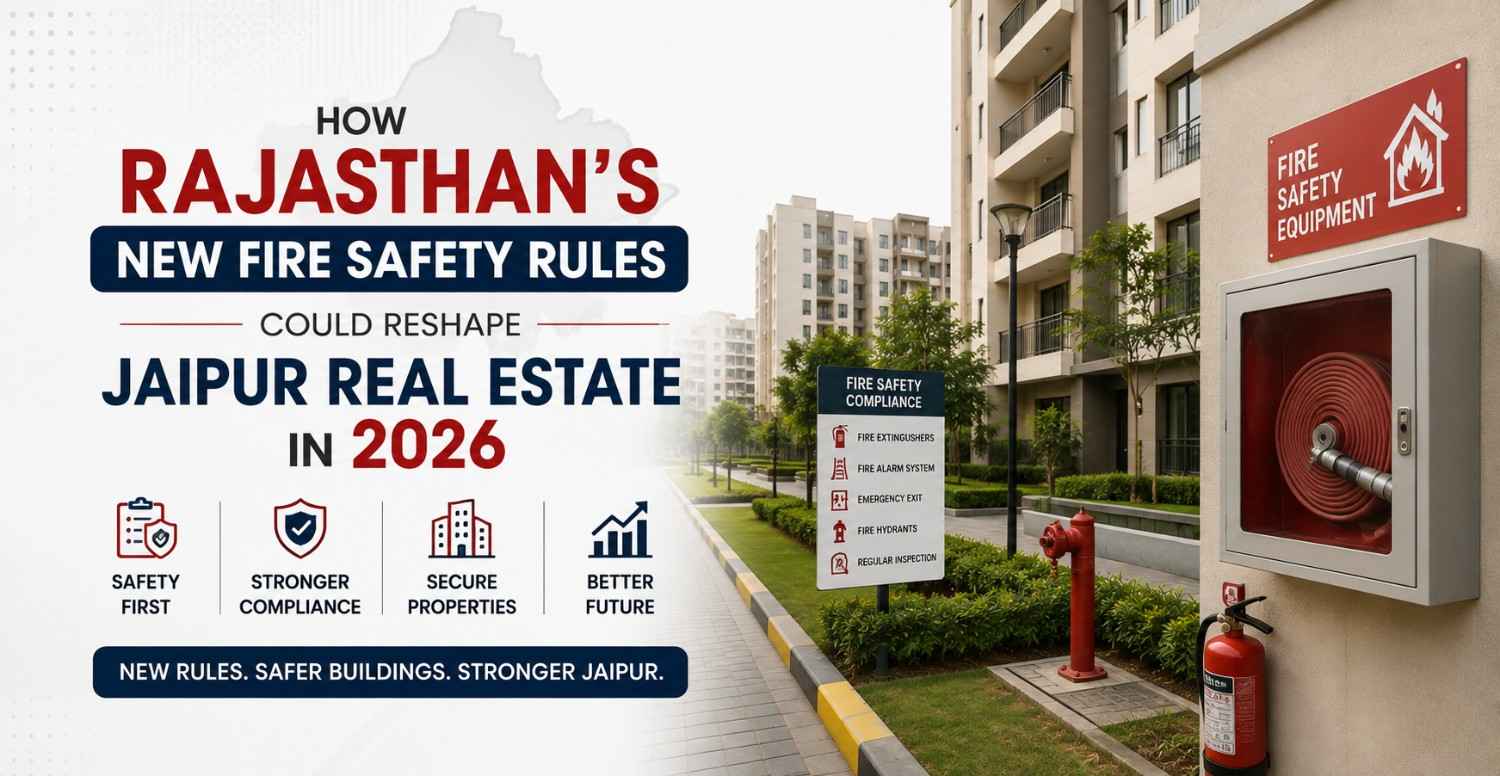
The Rajasthan fire safety rule 2026, effective from June 16, 2026, requires stricter fire-safety measures. Certain residential buildings of 9 metres or more or 250 sq and above and commercial buildings of 9 metres or more, may need a Fire NOC and at least two staircases. These rules could reduce usable space and increase construction costs, potentially affecting Jaipur property prices 2026, especially for smaller projects. For buyers, checking the Fire NOC and sanctioned building plan is essential.
Fire safety is becoming a much bigger part of the real estate conversation in Rajasthan. With the state implementing new fire-safety provisions in 2026, developers and architects in Jaipur are rethinking how buildings are planned, particularly on compact plots where every square metre matters.
For homebuyers and investors, the bigger question is simple: will these rules make Jaipur properties more expensive, reduce usable space or change where developers choose to build? The answer is nuanced, because the impact will vary by building height, plot size, use and compliance requirements.
The new framework is officially titled “Fire Provisions Relating to Fire Prevention, Life Safety and Fire Protection Measures for All Types of Buildings in the State of Rajasthan-2026.” It was implemented by the Local Self Government department following action by the Urban Development and Housing department in June 2026.
The objective is not simply to add another approval requirement. The framework consolidates requirements relating to fire prevention, evacuation, firefighting systems, life safety and building design.
One of the most important changes for Jaipur real estate is the staircase requirement. Buildings requiring a fire NOC must have a minimum of two staircases, which can materially affect layouts on smaller plots.
Based on the provisions reported by Rajasthan officials, key thresholds include:
The exact applicability can depend on the building's use, configuration and approval authority, so developers should verify the sanctioned-plan requirements before finalising a design.
The Rajasthan government's online building and fire-service systems also recognise Fire NOC as part of the building approval ecosystem. The state service portal currently lists Fire NOC with a stated service timeline of 15 days under Local Self Government services.
The most immediate impact is likely to be architectural.
A second staircase needs floor area, structural space, circulation and appropriate access. On a large residential project, that may be relatively manageable. On a compact urban plot, however, the same requirement can substantially change the floor plan.
Architects quoted in recent reports have specifically warned that the additional staircase could reduce usable carpet area and built-up area ratio, particularly on smaller plots.
Consider a developer planning a compact three-storey residential building. If a second staircase is required, space that could previously have been allocated to bedrooms, living areas, balconies or circulation may need to be reallocated.
This does not necessarily mean the total permitted construction area disappears. Instead, part of the available floor plate may be consumed by safety infrastructure.
That distinction matters for buyers: a project may have the same sanctioned built-up potential but offer slightly less saleable or usable space.
The impact is particularly significant within JDA areas because three-storey buildings can fall close to the 9-metre threshold. ETRealty reported that architects believe many such buildings could come under the new fire-safety requirements.
This creates an important design consideration: floor-to-floor height, staircase planning, setbacks, circulation and services need to be evaluated together.
Developers should not treat the 9-metre threshold as a target to work around. Authorities have already expressed concern that sanctioned plans could understate height while actual construction exceeds it.
The fire NOC process is becoming more central to project planning.
Rajasthan's official Local Self Government portal describes a Fire NOC as certification that premises conform to required fire-safety measures and the service is integrated into the state's online approval ecosystem.
For developers, the practical change is that fire compliance needs to be considered before the architectural layout is locked.
A typical planning approach should include:
The state has also published the Rajasthan Building Bye Laws 2025 and related building-regulation material, meaning fire compliance should be considered alongside the broader building approval framework rather than in isolation.
So, what does all this mean for the Jaipur real estate market 2026?
The first effect is likely to be project-level cost and design pressure, rather than an immediate citywide property-price shock.
Developers may face additional expenditure on:
These costs could eventually influence the pricing of newly launched projects. However, developers have several ways to absorb or distribute these expenses, including redesigning projects, increasing efficiency, changing unit configurations or adjusting launch prices.
Possibly, but it would be misleading to attribute future Jaipur property appreciation entirely to fire-safety regulations.
Current Jaipur pricing is already influenced by multiple factors, including infrastructure, land values, construction costs, demand, locality and project quality. Housing.com currently reports an average Jaipur property rate of around ₹5,930 per sq ft, with substantial variation between localities.
Magicbricks' April-June 2026 data also shows significant locality-level differences, with average apartment rates ranging from roughly ₹4,406 per sq ft on Ajmer Road to ₹12,360 per sq ft in Ashok Nagar.
This demonstrates why Jaipur property prices 2026 should be analysed locality by locality rather than through one citywide number.
The new rules may create both cost pressures and value benefits.
| Factor | Likely Effect on Developers | Potential Effect on Buyers |
|---|---|---|
| Second staircase | Higher construction/use-of-space cost | Potentially lower usable area |
| Fire NOC compliance | More planning and documentation | Greater confidence in approved projects |
| Firefighting infrastructure | Higher upfront cost | Better safety and long-term usability |
| Smaller plots | Greater design pressure | Fewer highly space-efficient projects |
| Compliant buildings | Better regulatory certainty | Potentially stronger resale appeal |
| Non-compliant construction | Greater regulatory risk | Higher legal and investment risk |
The key point is that compliance can become a value differentiator.
A buyer may be willing to pay more for a properly approved project with documented fire-safety systems, reliable evacuation arrangements and clear completion or occupancy documentation.
This is one of the most practical concerns.
If a developer cannot increase the overall permissible built-up area but must allocate additional floor space to staircases and safety infrastructure, the saleable efficiency of a project can decline.
There are three possible responses:
The outcome will differ by project.
For buyers comparing properties, this makes carpet area more important than simply comparing quoted prices per square foot. A cheaper-looking apartment is not necessarily better value if its usable area is significantly lower.
For investors, the new framework adds another layer to due diligence.
A property should not be evaluated solely on its location, rental potential or quoted appreciation.
Before investing in a multi-unit or commercial project, check:
This is particularly important for older buildings and properties where additions or alterations may not match the original sanctioned plan.
Expert Tip:- Do not ask a developer only, “Does this project have a Fire NOC?” Ask whether the NOC corresponds to the actual sanctioned building configuration.
The smartest response is not to treat the regulations as a last-minute compliance hurdle.
Instead, developers can build fire safety into the initial design strategy.
Architects should identify fire-NOC requirements before fixing unit layouts. This reduces the possibility of expensive redesigns later.
A well-planned staircase can minimise the loss of functional floor area while still providing safe evacuation routes.
If smaller plots become harder to design efficiently, developers may increasingly favour land parcels where safety infrastructure can be accommodated without sacrificing too much saleable space.
Fire safety should become part of project communication, not merely an approval document hidden in the paperwork.
Platforms and property advisors such as Search Abode can also help buyers compare projects, but buyers should independently verify regulatory documentation before making a transaction.
The impact is mixed. In the short term, developers may face higher design costs, slower approvals and reduced efficiency on smaller plots. These costs could put some upward pressure on prices or lead to smaller apartment layouts.
In the long term, stronger fire-safety standards can improve building quality and buyer confidence. With Rajasthan moving away from older height restrictions based on firefighting ladder reach, projects that meet modern safety requirements may support more organised vertical development.
If you plan to buy property in Jaipur, include fire-safety compliance in your due diligence.
Before paying a booking amount:
For investors, regulatory compliance should be treated as a property-value factor, not just an administrative formality.
The Rajasthan fire safety rules 2026 may significantly influence building design in Jaipur, especially for residential and commercial projects requiring a Fire NOC. Additional staircases and safety systems could increase costs and reduce design flexibility on smaller plots.
For buyers, compliance should be part of the decision-making process. Instead of assuming these rules will automatically raise Jaipur property prices 2026, compare each project’s usable area, approvals, location, construction quality and fire-safety standards.
The Rajasthan Fire Safety Rules 2026 introduce stricter fire prevention, evacuation and life-safety requirements for different types of buildings across Rajasthan.
Certain multi-unit residential buildings of 9 metres or more or 250 sq m and above, along with commercial buildings of 9 metres or more, require fire-safety approval under the applicable rules.
Buildings that require a Fire NOC generally need at least two staircases, which can affect floor planning and usable space.
The rules may increase construction and compliance costs and require changes to building layouts, particularly for projects on smaller plots.
A Fire NOC indicates that the applicable fire-safety requirements have been addressed. Buyers should ensure the approval corresponds with the actual building configuration.