Published on: 27 November 2026
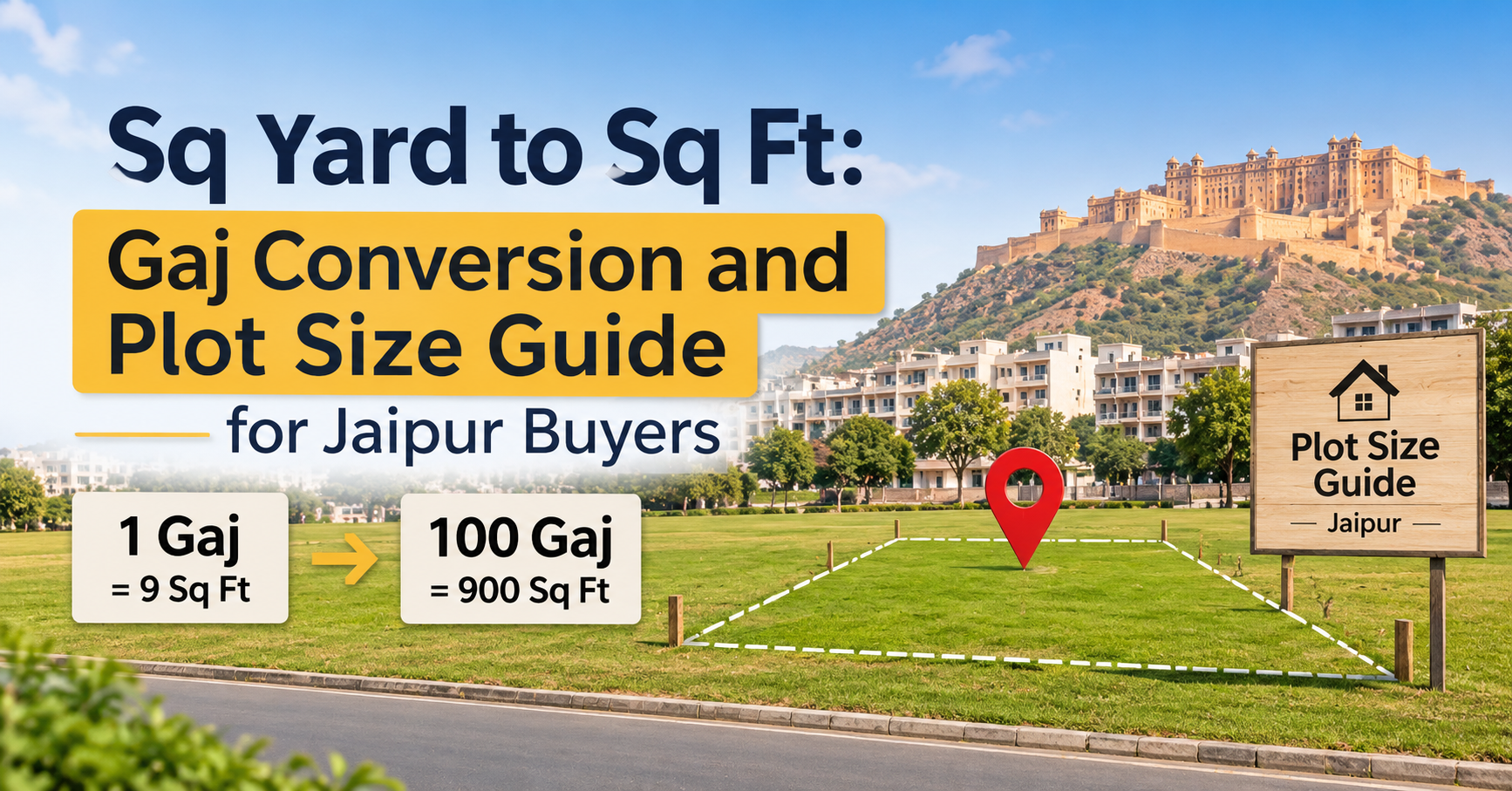
1 sq yard = 1 gaj = 9 sq ft, or about 0.836 sq m. To convert sq yard to sq ft, multiply by 9. So a 100 gaj plot size is 900 sq ft and a 200 gaj plot is 1,800 sq ft, which is also the gaj to sq ft in Jaipur rule. Before paying, confirm the plot's actual dimensions and the unit used in the sale deed or layout plan.
If you are browsing plots for sale in Jaipur you will see sizes quoted in gaj or square yards, not square feet. Knowing the sq yard to sq ft conversion is the first step to judging a plot's real size, comparing rates fairly and planning your home. A 100 gaj plot size is one of the most common starting points.
The rule is simple: 1 square yard equals 1 gaj, which is 9 square feet. This guide gives you the formula, a quick conversion table, common plot sizes and the checks to run before you pay for any plot.
Gaj is a traditional unit of area used across north India, including Rajasthan, Delhi, Haryana, Punjab and Uttar Pradesh. In real estate, gaj means the same thing as a square yard. A plot of 100 gaj is a plot of 100 square yards.
In Jaipur, builders, brokers and sellers still quote residential plots in gaj, and rates are often given per gaj. Buyers who think in square feet sometimes get confused, so it helps to convert every number into one unit before comparing options.
The formula is straightforward:
Area in sq ft = Area in sq yards (gaj) × 9
To go the other way, divide square feet by 9. For example, a plot of 1,350 sq ft is 1,350 ÷ 9 = 150 gaj.
If you want the area in square metres, multiply the gaj by 0.836. A 100 gaj plot is about 83.6 sq m.
Because 1 sq yard equals 1 gaj, the same table works for both units. Use it for quick checks while comparing plots:
| Plot size (sq yard / gaj) | Area in sq ft | Area in sq m (approx.) |
|---|---|---|
| 50 | 450 sq ft | 41.8 sq m |
| 60 | 540 sq ft | 50.2 sq m |
| 80 | 720 sq ft | 66.9 sq m |
| 90 | 810 sq ft | 75.3 sq m |
| 100 | 900 sq ft | 83.6 sq m |
| 120 | 1,080 sq ft | 100.3 sq m |
| 150 | 1,350 sq ft | 125.4 sq m |
| 200 | 1,800 sq ft | 167.2 sq m |
| 250 | 2,250 sq ft | 209.0 sq m |
| 300 | 2,700 sq ft | 250.8 sq m |
| 400 | 3,600 sq ft | 334.5 sq m |
A 100 gaj plot size works out to 900 sq ft, or about 83.6 sq m. It is one of the most common sizes for a compact independent home. Common dimensions include 20 × 45 ft and 30 × 30 ft, though the exact shape depends on the layout.
Two plots can both be 100 gaj and still feel very different. A wide plot with a short depth gives better frontage, while a narrow, deep plot can limit light and ventilation. Always ask for the length and width, not just the gaj figure.
A 200 gaj plot in sq ft is 1,800, or about 167.2 sq m. It suits a larger family home or a house with a garden and parking. Typical dimensions include 30 × 60 ft and 40 × 45 ft.
Because the area is bigger, price differences between locations matter more here. A 200 gaj plot in an established colony can cost very differently from the same size on the city's outer belt, even though the area is identical.
The units you will meet most often in Jaipur are related like this:
Some older records and listings use slightly different values, such as 8.9 sq ft per gaj, so always match the unit used in the document you are reading.
You do not always have a calculator at a site visit. For a quick sq yard to sq ft estimate, multiply the gaj by 10 and then subtract the gaj itself. For 150 gaj, that is 1,500 minus 150, which gives 1,350 sq ft. Another shortcut is that every 10 gaj adds 90 sq ft, so 10 gaj is 90 sq ft, 20 gaj is 180 sq ft and so on.
Sellers often quote a rate per gaj, while online portals and builders may show a rate per sq ft. Divide the rate per gaj by 9 to get the rate per sq ft.
Here is an illustrative example (not a market price): if a plot is offered at ₹60,000 per gaj, the rate per sq ft is ₹60,000 ÷ 9 = about ₹6,667. For a 100 gaj plot, the total would be ₹60,000 × 100 = ₹60 lakh.
Use this method to compare two offers on the same basis. A plot that looks cheaper per gaj may cost more once you account for its real size, road width and approvals.
Suppose a listing reads: 150 gaj, 30 × 45 ft, east-facing, 30 ft road, ₹55,000 per gaj. This is an illustrative example, not a market price. Here is how to check it:
If the length and width do not multiply to the stated area, ask the seller to explain the difference before you move ahead. Small mismatches often come from irregular shapes, rounded numbers or different units.
The area you can actually build on is not the same as the plot area. Setbacks, ground coverage and the number of floors allowed depend on the building rules of the approving authority, so confirm these before you plan a design. Our guide to the Jaipur Master Plan 2047 explains how zones affect what can be built on land.
Converting sq yard to sq ft takes one step: multiply by 9. Once you convert every plot size, from a 100 gaj plot size to larger plots, and every rate into the same unit, comparing options becomes easier and you are less likely to overpay or misjudge a plot.
Always back the numbers with documents, a site measurement and an approved layout before you pay. If you would like help shortlisting verified plots in Jaipur, the Search Abode team can guide you.
One square yard equals 9 sq ft. In real estate, it is the same as 1 gaj.
A 100 gaj plot is 900 sq ft, or about 83.6 sq m.
A 200 gaj plot is 1,800 sq ft, or about 167.2 sq m.
Yes. In real estate, gaj and square yard mean the same thing. 1 gaj = 1 sq yard = 9 sq ft.
Divide the area in square feet by 9. For example, 2,250 sq ft ÷ 9 = 250 gaj.
Multiply the number of square yards by 9. As a mental shortcut, multiply by 10 and subtract the original number.