Published on: 23 April 2026
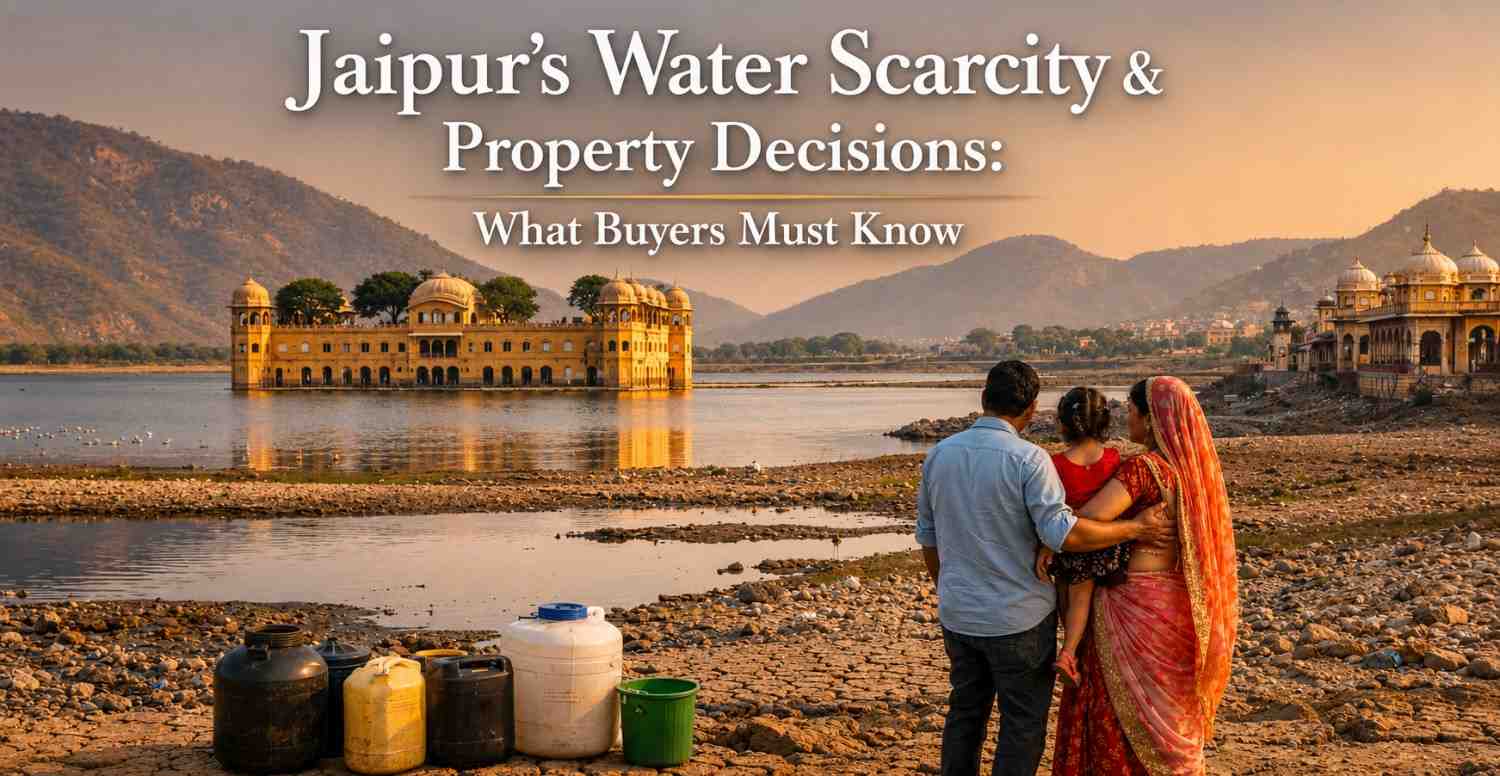
Jaipur the Pink City known for its historic forts, vibrant culture, and booming real estate market is now wrestling with a deepening water crisis that’s beginning to shape how people live, invest, and buy property. With rapid urbanisation, rising temperatures, and the perennial strain on limited water resources, buyers need water awareness alongside location and price when choosing homes in Jaipur.
Despite infrastructure upgrades, many city locals are already facing reduced daily water supply especially in historic and dense neighborhoods like the Walled City, where scheduled water hours have shrunk and pressure dropped significantly even before peak summer arrives. Residents report relying on private water tankers and long queues for basic household needs.
High demand, limited supply, and inadequate pipeline reach have driven up private tanker prices, with residents in several areas paying many times more than standard rates to meet basic requirements.
Jaipur’s main water lifeline Bisalpur Dam still struggles to keep up with demand; official figures show supply falls short of actual urban usage, and the city must grapple with both quantity and quality issues.
Modern property buyers are increasingly valuing water-secure localities over traditional hotspots. Areas with reliable municipal supply, high groundwater recharge potential, rainwater harvesting systems, and community water management are becoming more desirable and even commanding price premiums.
Homes in areas with chronic supply gaps or over-exploited ground water tables may face stagnant prices or slower appreciation especially as more professionals and families prioritise livability and sustainability.
Properties that require constant use of private tankers or borewells not only increase monthly living expenses but can also hurt long-term resale value. Buyers should factor in ongoing water costs when computing the true cost of ownership.
Recognising the urgency, the Rajasthan government and central schemes are rolling out several ambitious programs.
Under the Jal Jeevan Mission and hybrid annuity models, Rajasthan is launching projects worth over ₹18,000 crore to expand water supply to villages and urban fringes which indirectly eases strain on Jaipur by improving regional distribution networks.
The state has approved ₹5,120 crore for drinking water improvements across cities, including pipeline upgrades, reservoirs, and smart metering for Jaipur, part of broader reforms under Amrut 2.0.
The Mukhya Mantri Jal Jeevan Mission (MMJJM), funded with nearly ₹5,830 crore, aims at strengthening urban water infrastructure critical for property owners counting on reliable supply.
Over ₹130 crore in CSR support has been mobilised to support innovative water conservation projects and strengthen rural and peri-urban water resilience which ultimately benefits Jaipur’s wider hydrological footprint.
Rajasthan ranks third nationally in water conservation and groundwater recharge efforts, supported by a range of community participation schemes, traditional water structures, and modern recharge systems.
As a homebuyer, thinking water-wise can future-proof your investment and improve quality of life. Here’s how:
Ask the developer or local residents about:
Areas with healthy groundwater recharge and less extraction pressure offer better long-term sustainability than regions heavily reliant on borewells.
Look for communities that integrate:
These features aren’t just eco-friendly they can reduce monthly utility costs and buffer supply disruptions.
Review Jaipur Development Authority (JDA) maps and master plans to understand:
Properties with green certification, energy-efficient building practices, and water-smart infrastructure are increasingly sought after and may offer higher resale value in a water-aware market.
Jaipur’s real estate landscape is rapidly evolving and water security is now a core element of property value, community desirability, and livability. Prospective buyers should approach investments not just through the lens of price per square foot, but through water sustainability, infrastructure resilience, and community resource planning.
Buying a home in Jaipur today means understanding the city’s water story not just its skyline.
Start your property search the right way with Search Abode.
Water scarcity can reduce demand and slow appreciation in areas with unreliable supply, while water-secure localities may see higher property values.
Older and densely populated areas, including parts of the Walled City and peripheral zones dependent on tankers or borewells, often face shortages.
Reliable water supply directly impacts daily living, maintenance costs, long-term sustainability, and resale value.
Water-smart communities include features like rainwater harvesting, groundwater recharge systems, greywater recycling, and efficient water management.
Yes, reliance on private water tankers and borewell maintenance can significantly increase monthly living expenses.