Published on: 22 September 2026
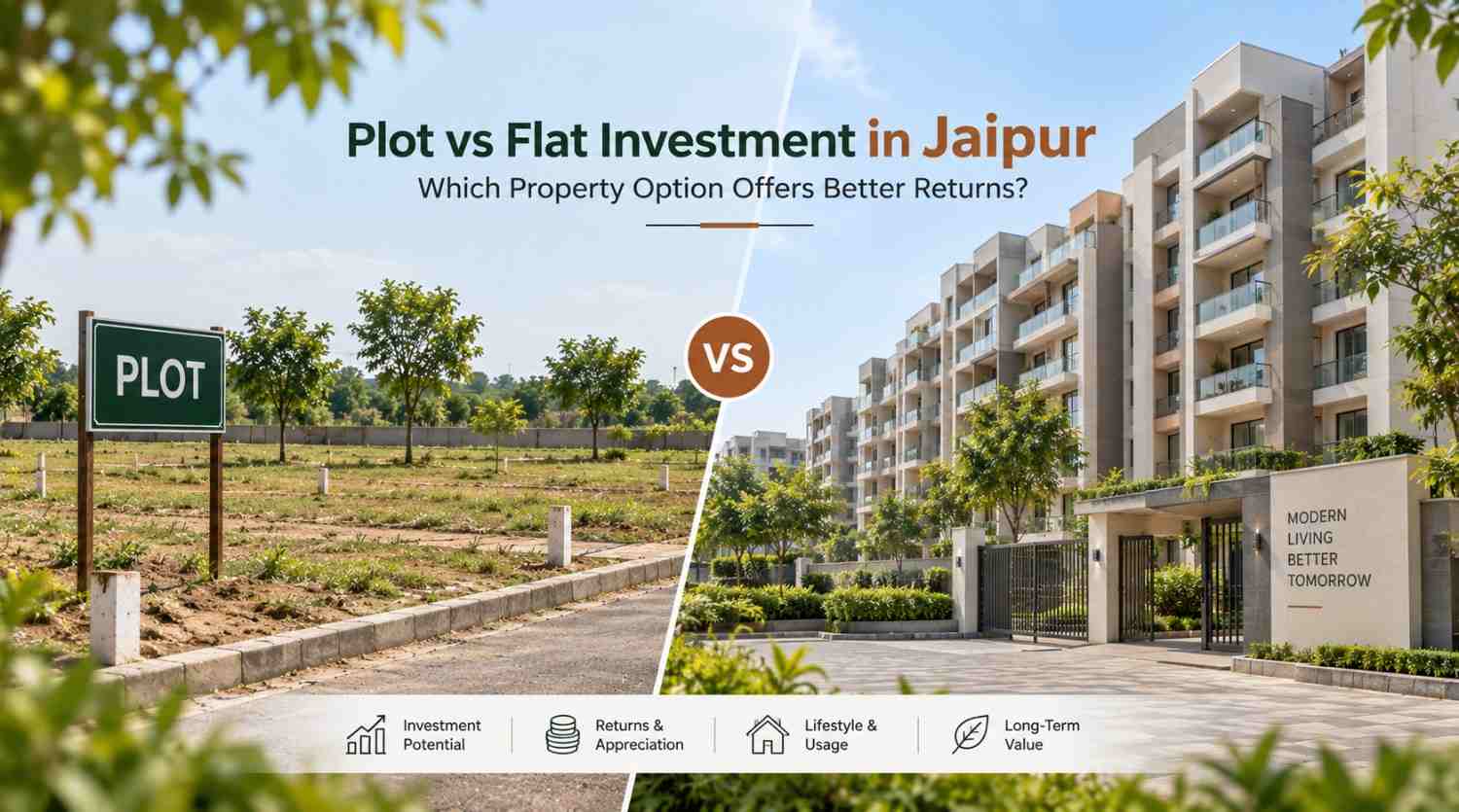
Plot vs Flat: Which is better for investment? A plot is generally focused on land ownership and long-term appreciation, while a flat offers constructed space, potential rental income and immediate usability. The key plot and flat difference is that plots provide more flexibility for future construction, whereas flats can generate rental returns without requiring separate construction. Your choice should depend on your budget, investment period, rental-income needs, location and long-term goals.
Choosing between a plot and a flat in Jaipur can be confusing, especially when both options are available at similar price points. A flat may offer an easier path to rental income and immediate occupancy, while a plot gives you ownership of land with the flexibility to construct later. So, when comparing plot vs flat, the real question is not simply which property is cheaper, it is which one fits your investment objective.
Jaipur’s expanding residential areas and infrastructure development have created opportunities across both plotted developments and group-housing projects. Rajasthan RERA’s current project database shows that both plotted developments and group-housing projects are active in Jaipur’s real estate market.
A plot is the parcel of land that you own and can potentially develop according to applicable planning and building regulations. A flat is an apartment within a residential building, where you own the apartment along with the applicable share or rights in common areas.
The main plot and flat difference comes down to what you are actually investing in.
With a plot, the actual land is the primary asset. With a flat, you are purchasing a constructed residential unit whose value is influenced by the building, apartment specifications, amenities, location and the actual land.
Rajasthan RERA treats plotted developments and apartment projects as separate types of projects. For plotted projects, details usually include the plot size, while apartment projects provide details such as carpet area and other flat specifications.
| Factor | Plot | Flat |
|---|---|---|
| Initial investment | Can vary significantly by location and plot size | Depends on size, floor, project and amenities |
| Rental income | Usually limited unless developed | Generally suitable for rental income |
| Construction | Construction cost comes later | Already constructed or included in project purchase |
| Maintenance | Usually lower before construction | Regular maintenance and society charges |
| Customization | Greater flexibility after approvals | Limited to permitted modifications |
| Appreciation drivers | Primarily land, location and infrastructure | Location, building quality, demand and land component |
| Liquidity | Depends heavily on location and buyer demand | Depends on project, location, pricing and condition |
| Depreciation | Land itself does not depreciate like a building | Building component can age over time |
| Possession/use | May require construction before use | Ready-to-move flats can be used immediately |
| Rental potential | Usually requires construction | Can generate rent after possession |
The table highlights why comparing only the purchase price can give an incomplete picture.
A plot gives you direct exposure to land. If the surrounding area experiences infrastructure improvements, increased housing demand or commercial activity, land values can potentially benefit.
However, appreciation is location-specific. A plot in an area with weak connectivity or limited development should not automatically be expected to outperform an apartment in a well-established locality.
One major advantage of a plot is the ability to plan construction according to your future requirements, subject to applicable approvals and regulations.
For example, an investor could initially hold the land and later construct a residence when finances and personal requirements allow.
An undeveloped plot generally does not have the same recurring building maintenance requirements as an occupied apartment.
That said, investors should still account for property taxes, security or development charges where applicable, and other ownership costs.
A plot can be used for different purposes depending on zoning, permissions and applicable regulations. This flexibility can become valuable as the investor's needs change.
For investors looking for regular income, a flat has a significant practical advantage: it can be rented after possession.
Rental demand can vary depending on proximity to workplaces, educational institutions, transport, shopping areas and established residential infrastructure.
If your objective is to eventually live in the property, a flat can provide a more straightforward solution than buying land and arranging construction separately.
Ready-to-move apartments can also eliminate the waiting period associated with construction, subject to the property's actual possession and documentation status.
Many modern apartment projects provide facilities such as:
These facilities can improve convenience and potentially support tenant demand, although they also contribute to maintenance costs.
Buying from a properly documented residential project can reduce some of the practical responsibilities associated with independently developing land.
However, investors should still conduct due diligence. Rajasthan RERA provides project-level information and registration details that buyers can use to verify applicable projects.
There is no fixed answer because appreciation depends heavily on micro-location and purchase price.
A plot may have greater long-term appreciation potential when it is located in an area where roads, infrastructure, employment and residential demand are expanding. Since the land remains the underlying asset, there is no apartment structure becoming older on the same basis.
Therefore, instead of asking only, "Which appreciates more?", investors should ask:
This is where flats generally have a practical advantage. An apartment can be rented once it is legally ready for occupation, allowing the investor to generate recurring income. The rental return can then supplement potential capital appreciation.
A vacant plot normally does not produce meaningful rental income unless it is developed or used for an income-generating purpose permitted by applicable regulations.
For example, consider two hypothetical investments:
The flat generates ₹2.4 lakh gross annual rent, equivalent to a 4.8% gross rental yield before maintenance, vacancy, taxes and other costs.
This doesn't automatically make the flat the better investment. If the plot appreciates significantly more over the same period, its overall return could still be higher. That is why investors should compare total return, not just rental yield.
Affordability depends on location, size and development stage. A small plot in an emerging Jaipur locality may cost less than a premium apartment in an established area. However, the plot buyer must consider future construction expenses.
For a flat, the purchase price may already represent a substantial portion of the total acquisition cost, but buyers still need to account for registration-related costs, interiors, maintenance, parking-related charges where applicable and other expenses.
For a plot, calculate:
Total Investment = Plot Cost + Registration/Transaction Costs + Development Costs + Construction Cost
For a flat:
Total Investment = Flat Cost + Registration/Transaction Costs + Interiors + Other Applicable Charges
This calculation gives a more realistic comparison than looking at the advertised property price alone.
One of the biggest mistakes investors make is choosing between a plot and flat before choosing the right location.
A well-located flat can perform better than a poorly located plot, and a strategically located plot can outperform an apartment in a weaker micro-market.
When evaluating Jaipur property, examine:
JDA's Jaipur-region planning documents emphasize coordinated planning for housing, mobility, infrastructure, land management and other development requirements, making broader infrastructure context important when evaluating a location.
Regardless of the property type, due diligence is essential.
Check:
Check:
Rajasthan RERA's database provides project information for registered developments, including project type, location, promoter details and status. Current listings show both plotted and group-housing projects in Jaipur.
Use this simple five-step framework:
Are you investing for:
Include acquisition costs, taxes, registration, construction or interiors, financing costs and maintenance.
Compare the same micro-market wherever possible. Don't compare a peripheral plot with a premium central flat and draw conclusions about property type alone.
For a flat, consider:
Total Return = Capital Appreciation + Rental Income − Ownership Costs
For a plot:
Total Return = Capital Appreciation − Ownership Costs
These are simplified investment calculations, but they help you think beyond the purchase price.
Check documentation, approvals, title, project registration where applicable, infrastructure and actual market demand.
Platforms such as Search Abode can also be useful when researching property options and comparing available residential opportunities, but final investment decisions should be based on independent due diligence.
The plot vs flat decision in Jaipur ultimately depends on what you want your property investment to accomplish. A plot can offer greater flexibility and potentially strong long-term land appreciation, while a flat can provide immediate usability, amenities and the possibility of recurring rental income. Neither option guarantees higher returns and location, purchase price, holding period and demand can have a greater impact than the property category itself.
Before investing, compare the complete financial picture rather than focusing only on appreciation. Evaluate the difference plot and flat, calculate potential rental income and ownership costs, examine the micro-location and verify legal and project documentation. A property that matches your financial goals and investment timeline is generally more relevant than simply choosing one property type over the other.
A plot can be suitable for long-term capital appreciation and future construction, while a flat may be better for investors seeking rental income and immediate usability. The better option depends on your budget, location, investment horizon and financial goals.
The main difference between a plot and a flat is what you own. A plot primarily represents ownership of land, while a flat is a constructed residential unit within a building, along with applicable rights in common areas.
Generally, flats have greater rental-income potential because they can be occupied by tenants after possession. A vacant plot typically does not generate regular rental income unless it is developed for an approved income-generating use.
A vacant plot generally has fewer routine maintenance requirements than a flat. Flats typically involve maintenance charges, repairs, common-area expenses and other society-related costs.
Not necessarily. Property prices depend on location, size, development, amenities and market demand. A plot may have a lower purchase price in some emerging areas, but construction costs must also be considered.